
Industrial Ventilation.
Tailored solutions designed to fit the customer’s needs
Problem
A Midwest product manufacturer came to IAS with a pressing need. Their current dust collection system was old, aging, and breaking down. It didn’t have the capabilities to allow for continued production that the manufacturer wanted. The customers current waste disposal system was messy and involved a trash compacter that would continually jam. This aging system drastically increased the level of maintenance labor required just to keep the system running.
They could not continue with their current system.
The Challenge
This project had multiple customer requests that needed to be considered in the final design of the system. The first challenge was the customers’ material composition, the material from the main cutting plainer came off as a long stingy, clingy and lightweight material. This stringy material loved to bridge over the existing systems’ airlock due to its lightweight nature. This had to be considered in the design and sizing of the collector and the airlock especially.
The second challenge was that the customer wanted to recycle the material in a space saving manner without using a trash compactor. A garbage truck was not able to get down the service road to the collectors’ location. The recycled material needed to be collected in a manageable fashion that minimized the work required by the maintenance team who would handle the collected material.
Finally, the material was explosive, although it was a low explosion risk all necessary NFPA protective equipment was required to ensure the safety of both the workers and the manufacturing building.
The Solution
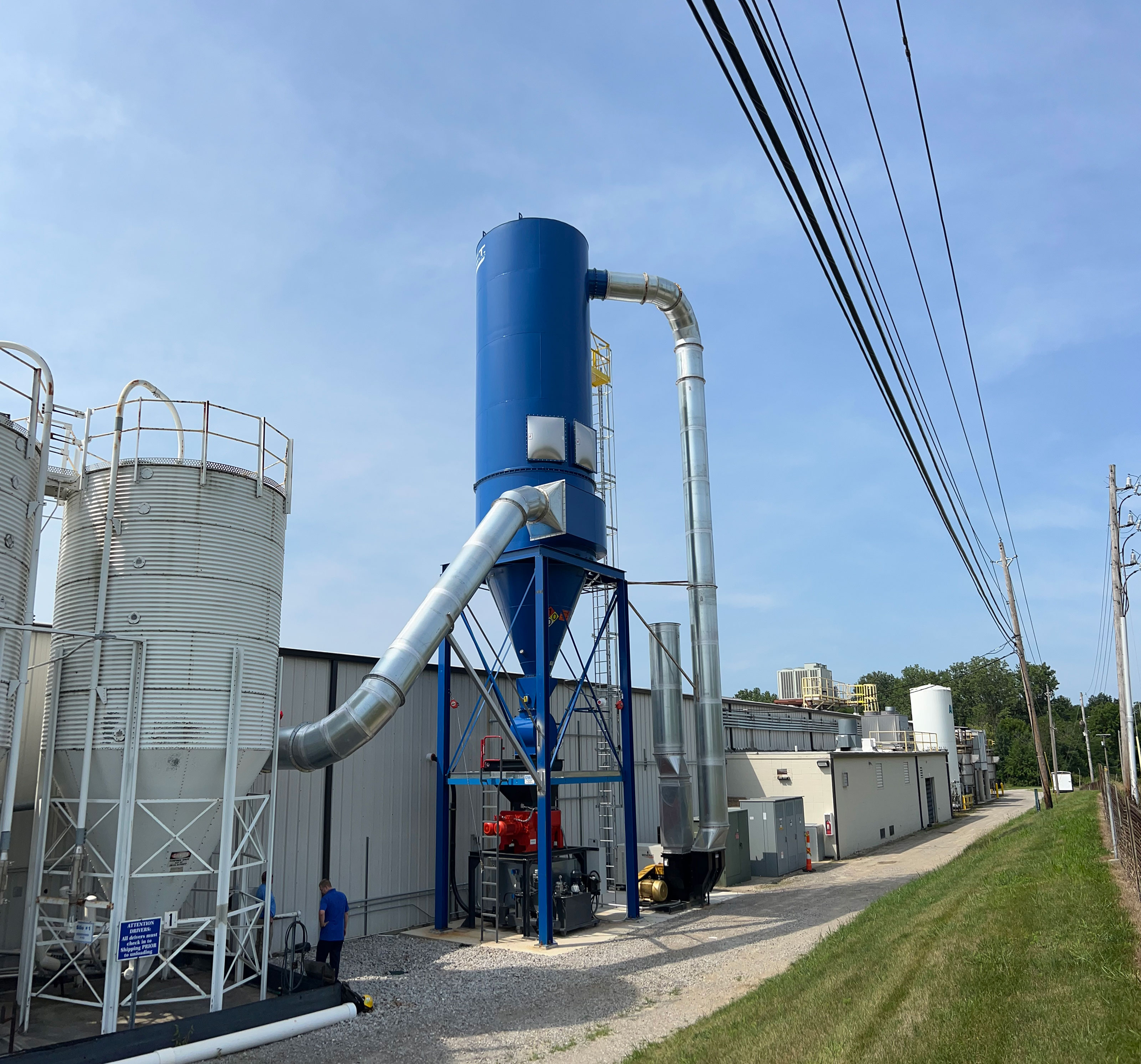
Every challenge for this project needed to be carefully considered in order to satisfy the customers’ needs. To account for the long stingy material, IAS turned to ACT Dust Collectors who supplied an ACT ARB-260 cyclonic baghouse with 10’ bags. This baghouse combines a cyclone and a baghouse to spin out a majority of the product before it entered the baghouse section, greatly increasing the lifespan of the bags over a standard baghouse. A Honeyville 24 inch airlock was installed below the baghouse, designed to be so large that the material wouldn’t be able to bridge across the airlock inlet. IAS engineered the duct layout to ensure proper convey velocity, with the help of Lapine Metal Products who we used their easy to install CheetahDuct quick clamp ductwork. The system was powered by a Chicago Blower Design 95 blower, engineered to move a massive amount of air at high levels of static pressure (W.G”).
To satisfy the customers’ needs of recycling their collected material, IAS turned to Weima for their engineered recycling solutions. First the material would leave the airlock to be shredded by the Weima shredder then it enters the Weima Briquetter where the material is compacted into “pucks” just slightly larger than a hockey puck. From the Briquetter the material was conveyed into a set of 5 super sacks supplied by the customer located inside. A scale was located under each super sack that measured the weight of the collected pucks, once the threshold was hit that bag would automatically close and the pucks would be conveyed to the next super sack waiting to be filled.
To account for the explosive nature of the collected material, IAS turned to Boss Products for their Vigi-Flap to protect the building from an explosion in the baghouse. To further prevent an explosion from happening, IAS used Flamex’s spark detect and extinguishing system to prevent any sparks from reaching the baghouse.
Results
All of the products were carefully chosen and included into our engineering scope to satisfy the needs of the customer. The ACT collector paired with the Chicago Blower Fan and properly sized Lapine CheetahDuct effectively conveyed, collected & filtered the material into clean air. The Honeyville 24” airlock removed the material from the bottom of the baghouse without bridging and to the addition of a feeder box that allowed for the lightweight, stringy material to fall out of the cyclone section of the baghouse and into the airlock inlet. The collected material fell into the Weima shredder where it was shredded and briquetted into recyclable pucks.
Project Success Points
This project had multiple different aspects that needed to be thoroughly accounted for in order for the successful operation of the customers’ manufacturing flow. The ACT cyclonic baghouse removed the stringy particulate from the airstream. One of the biggest concerns about the material was its ability to bridge over everything that it can. The Honeyville 24” airlock and sloped feeder box eliminated this as a concern. They allowed for the effective removal of material from the bottom of the baghouse. Finally, the use of Weima for the material shredder and briquetter to generate easy to manage and recyclable pucks that are delivered into super sacks.
Companies Involved
- ACT
- Chicago Blower
- Lapine Metal Products
- Boss
- Flamex
- Honeyville (airlock)
- Weima
Get In Touch
Need a solution? Let us know how we can help. Get a quote or reach out with any questions. Contact us 
More Projects
How can we help
Get a quote or reach out with any questions.

(616) 538-2000